Hometown History: Springs of Ocean Springs
OCEAN SPRINGS, Miss. (WXXV)- Modern-day Ocean Springs is a city known for its arts, culture, and coastal charm, but the story of how the city got its name is a unique piece of history that can still be seen today.
In this month’s edition of Hometown History, WXXV’s Megan Fayard takes us to the natural mineral springs, a piece of history that played an instrumental role in shaping the Ocean Springs community.
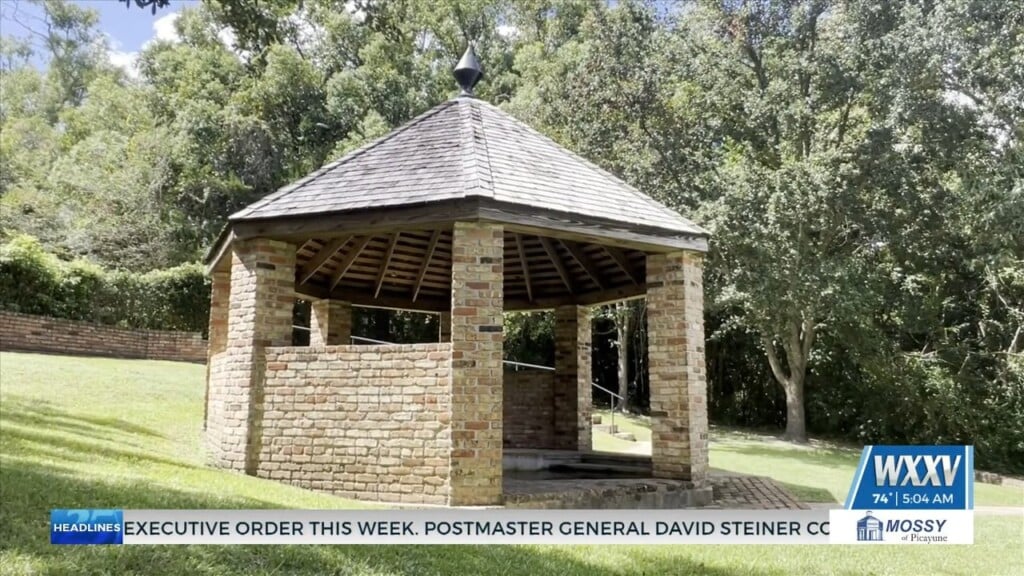
From native tribes to European settlers, for centuries, Marble Spring and Indian Spring, in what is now the City of Ocean Springs, were believed to possess healing and spiritual powers because of their mineral rich water. Ocean Springs Historian Ray Bellande said, “It’s basically the nascent, the beginning of the town’s history had a lot to do with the discovery of the springs.”
Though the springs no longer function as they once did, both springs are still standing today and the stories and traditions surrounding them have had a lasting influence on the area. “You have to recall medicine was pretty primitive at this time and hydrotherapy was a big thing. People believed in the power, the efficacious nature of water.”
The known story starts in the 1850s when Reverend Phillip P Bowen and James Lynch discovered the mineral springs and constructed marble baths at the site on Iberville Drive, now known as Marble Springs.
People came from across the Gulf Coast for treatments in the medicinal waters known for their healing properties.
According to the Ocean Springs archives, the water contained minerals including iron, Sulphur, and magnesia. Visitors believed that bathing in the minerals would provide relief from ailments such as indigestion and fatigue.
As the springs grew in popularity, travelers from New Orleans and Mobile made their way to the small town and a need for sufficient accommodations grew. This resulted in a health resort called the Ocean Springs Hotel. “A doctor in New Orleans, his name was Dr. Austin, built a hotel and guess what the name was? Ocean Springs. The hotel was quite large. It was on Jackson Avenue and Calhoun, of course it faced the water. So, Dr. Austin decided, well, you know, ‘I’ve got patients in New Orleans. I can put them up in my hotel.’ The steamboat would land here at the foot of Jackson Avenue, and he had carriages that would take them, the patients, to the marble springs. See Dr. Austin had his built-in clients in New Orleans. They would come see him and he said, ‘oh! I got just the thing for you. You need to go to Ocean Springs. There’s a spring there that has this magical water. And I believe a lot of the prescription for using the springs was psychological, because people would come and lay in the water, and the water was not warm, probably ambient temperature, maybe cooler, and just the fact that they were in the mineral springs was gonna make them feel better, and they probably did.”
The town was briefly called Lynchburg Springs, but in 1854, it was renamed Ocean Springs, taking the name from the hotel. The hotel and springs helped drive tourism and growth in the rapidly developing area. “It’s an integral part of the city’s history to the point that you can’t talk about Ocean Springs, because, you know, springs, Ocean Springs, people using it. Coming in steam boats, we had a booming tourist industry. People have no idea how many small boutique hotels we had. There were probably 12 or 13 stretching Washington Avenue.”
Information remains limited regarding the Native American peoples believed to have used the springs centuries before European settlers arrived and eventually profited from their natural resources.
An archaeological excavation conducted in 1976 at the side of Indian Spring, in the area now associated with Aunt Jenny’s Catfish Restaurant, reportedly determined that Native Americans occupied the site during the Marksville period, approximately 1,500 years ago.
Though the sites remain today, water no longer freely flows to the springs, but their significance to the Ocean Springs community still stands as a piece of history worth saving.