Weather Balloons: A Key Tool Behind Every Forecast
When you think about weather forecasting, radar and satellites probably come to mind first. But one of the most important forecasting tools is something many people never see: a weather balloon.
Twice a day, National Weather Service offices across the country, including the New Orleans/Baton Rouge office located in Slidell, launch weather balloons equipped with a radiosonde that measure conditions high above the ground. The information collected is fed into forecast models, giving meteorologists a clearer picture of the atmosphere and helping improve the forecasts we rely on every day.
“This is important because with that information we’re able to collect, we can run that into forecast guidance, or forecast models, so that we’re able to predict whether its going to be a pretty benign day, like right now, or if its before a tropical system we can use that data to help determine where a storm may go,” said Rob Frye, lead forecaster at the National Weather Service New Orleans/Baton Rouge office.
As the balloon rises through the atmosphere, the radiosonde measures temperature, pressure and moisture while sending the information back to the National Weather Service roughly every second.
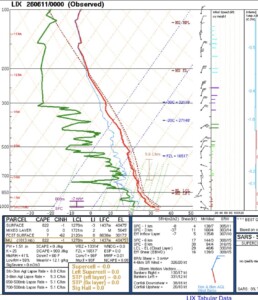
KLIX Skew-T Diagram from 0Z 6/11/2026
Before launch, the balloon is filled with 500 grams of hydrogen. That amount is carefully calculated to make sure the balloon climbs at the proper speed.
“If its too slow the battery on the radiosonde may run out, but if its too fast, the data may not record properly,” Frye explained.
Because hydrogen is highly flammable, safety is a top priority during the launch. Forecasters take precautions to reduce static electricity and carefully handle the balloon before sending it into the sky.
While these launches happen every morning and evening, meteorologists at the Storm Prediction Center or the National Hurricane Center can also request additional “special soundings” when severe weather or tropical systems threaten. Those extra launches provide an even more detailed snapshot of the atmosphere, giving forecasters another valuable tool to help track storms and keep communities informed before dangerous weather arrives.
During our visit to the Slidell office, we conducted the evening weather balloon launch just after 6 p.m. The balloon climbed more than 100,000 feet into the atmosphere, reaching the stratosphere before expanding until it eventually burst.
And not to worry, the balloon and parachute that fall back to earth are made from biodegradable materials and are fully degraded within about 3 months.