Famed banyan tree still ‘in the ICU’
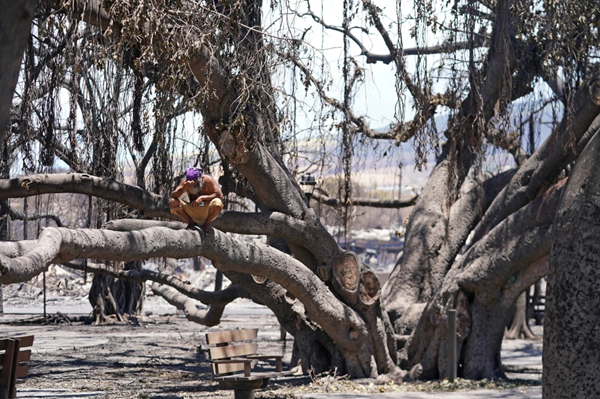
Lahaina’s iconic Indian banyan tree has been off limits to visitors since the August 2023 wildfire tore through the historic community, but some Maui County officials are hopeful that they might soon be able to restore public access.
Arborists from all over Maui — as well as a few from Oʻahu — will be organizing an extensive assessment of the tree’s health, the results of which will help determine when Lahaina Banyan Court Park might reopen, said Duane Sparkman, the chair of the Maui County Arborist Committee and the co-founder of the nonprofit Treecovery Hawaiʻi.
While many people hailed the famous tree’s survival as a symbol of hope and resilience, that initial optimism did not reflect the burn damage festering beneath the tree’s scorched bark, Sparkman said. Arborists discovered fungus inside a branch that snapped earlier this month and want to be sure the tree is not sicker than it appears.
“We really don’t know what’s under the skin,” he said. “It’s still trying to survive the fire, and it’s still trying to heal.”
The assessment is expected to be extensive and fairly invasive, Sparkman said. Arborists will tug on and throw ropes with weighted attachments over individual branches to see how much tension they can withstand, he said, and they will drive stainless steel spikes into the tree’s flesh to make sure it still produces sap and that there is a functioning cambium, a layer of tissue inside trees that is essential for growth and regeneration.
If the tree is healthy enough, Sparkman said Lahaina Banyan Court Park could reopen before the end of the year, but he did not want to make any predictions about what the arborists will find.
“We have to watch how any damage has healed over and what areas are safe,” he said, explaining that unhealthy branches could be at risk of falling on people and causing injuries. “Then we have to actually remove what’s not safe.”
Before arborists and officials determine when to reopen the park, they will also discuss whether to implement precautions to protect the tree and educate the public on how to behave so they do not further threaten it, Maui County Arborist Timothy Griffith Jr. said.
A fence currently prevents passersby headed to the recently reopened Lahaina Small Boat Harbor from getting too close to the famous tree, with signs warning against trespassing.
‘It’s In The ICU’
Lahaina Banyan Court Park is surrounded by reminders of the fire — the charred shell of the Old Lahaina Courthouse, melted lamp posts, vacant lots where restaurants and shops once stood — but the tree itself and the wooden benches around its trunk appear remarkably normal.
The fast-moving blaze skipped right over the park, Griffith said. Still, a large section of the famous tree was “superheated” near the intersection of Front and Hotel Streets, he said.
“The heat just dried out everything inside, almost like putting it in a kiln,” he said.
The upcoming assessment, which was authorized last week by the Maui County Arborist Committee but has not been scheduled, will help experts better understand how deep the damage runs, he said.
In the months after the fire, arborists went through the tree’s many trunks and branches and removed everything that had been dessicated by the fire, Sparkman said. Griffith said about 40% of the tree was removed in the year after the fire.
Treecovery — which cares for trees that survived the 2023 Lahaina and Kula wildfires and grows new trees to replace those that were destroyed — has worked alongside county officials and other volunteer arborists to water the banyan tree, inject hundreds of gallons of compost tea into nearby soil and prune dead or unhelpful roots and branches. So far, 22 trunks have already been removed, Sparkman said.
In some areas, aerial roots had begun to grow between the bark and the core — or heartwood — and allowed tiny beetles called twig borers to infest the tree, he said.
The tree has been treated for the bugs and no longer has any sign of beetles, but it is still very vulnerable, Sparkman said. During the islandwide rainstorm earlier this month, an 18-inch-diameter branch fell and revealed that there was fungus growing inside the tree.
“It’s a natural reaction for fungus to show up when it’s time for trees to break down, and in some cases, fungus spores can be on the bore beetles and the bugs that are in the tree itself,” Sparkman said. “We have concerns that it could be in other places in the tree, so that’s where the assessment has to come in.”
If fungus spreads enough, “it’s kind of over for a tree,” he added, and there is a much higher risk of branches falling on people and causing injuries.
The fire put a lot of stress on the banyan tree, Sparkman and Griffith said, so arborists are working hard to give it everything it needs to bounce back.
“It’s in the ICU. It’s like it’s been in a car crash and it’s injured, but it’s on its way to recovery,” Griffith said. “It’s still in recovery, so we’ll keep an eye on it. When it needs some TLC, we’ll be there.”
An Important Gathering Place
William Owen Smith planted a banyan tree sapling in the heart of Lahainatown in 1873. A century and a half later, it stood roughly 60 feet tall, had dozens of trunks and boasted an impressive network of limbs that stretched over two-thirds of an acre.
The shade created by the tree’s sprawling canopy made Lahaina Banyan Court Park a natural gathering place for generations of locals and tourists alike, said Theo Morrison, the Executive Director of the Lahaina Restoration Foundation.
“Shade is really, really important in Lahaina, and the tree gave that to people in a central location,” she said.
For years, the community kicked off the holiday season with the lighting of the banyan tree, and the park was the site of annual events like the International Festival of Canoes and Kamehameha Day celebrations.
Though the banyan tree is one of Lahaina’s most recognizable landmarks, many people also see it as a representation of the ways colonialism shaped the community and erased Native Hawaiian history. Smith, who planted the tree, came from a family of missionaries and played a role in the overthrow of the Hawaiian Kingdom.
The Lahaina Restoration Foundation, which for decades cared for the surrounding park using grant funding from the county, cares about the tree’s survival, but it does not celebrate its controversial history, Morrison said.
“It’s a beautiful tree, and it produces all that shade. That’s the value to the community,” she said.
The shadow cast by the banyan tree has become even more valuable since the fire, Morrison added. Lahaina once had about 25,000 trees — monkeypod, ʻulu, plumeria, kukui nut and more — lining the streets, but only about 1,000 to 4,000 survived the fire.
When Lahaina Banyan Court Park finally reopens, the tree will undoubtedly look different because so much had to be removed, Griffith said. Arborists hope that they can one day restore it to something close to its pre-fire shape by strategically pruning and planting propagated cuttings from the tree.
“It’s something that you have to plan in terms of decades, not just years,” he said. “You’ve got to let the tree do its own thing.”