Hikers describe intense rain and wind before floodwaters ravage Grand Canyon
Like clockwork, clouds build up in the afternoon, the wind starts to swirl and the skies darken. Then the rain comes.
Sometimes it is just a few drops. But on this August afternoon, the monsoon kicked into high gear, setting its sights on a remote section of the Grand Canyon’s North Rim. Down below, dozens of hikers were setting up camp along Bright Angel Creek and admiring the towering walls they eventually would have to traverse on the way back up.
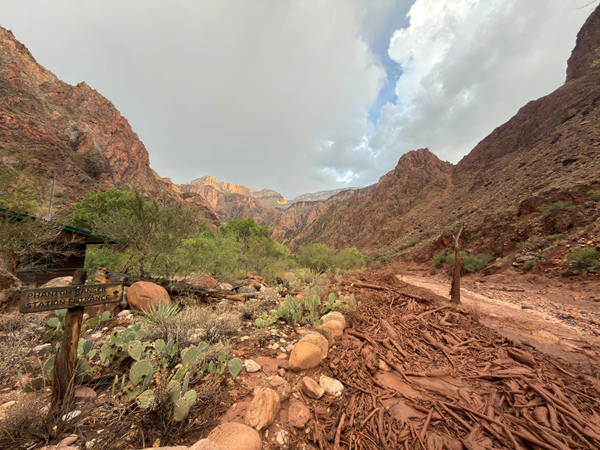
It wasn’t long before muddy water came rushing down the creek. The sound was deafening as it crashed against the rocks, carrying with it tree branches, sediment and other debris.
Violent thunderstorms and subsequent flash flooding are nothing new during the summer months in the southwestern United States. Those in the canyon last Saturday knew the risks, but this storm packed an extra punch, washing out key footbridges and doing more damage to infrastructure than previous decades of turbulent water.
Two people died and at least one is still missing. More than 80 people were airlifted out of the canyon, and the National Park Service is assessing the damage.
Forecasts warned of severe storms and flood risks
A storm of generational proportions — that is how some of the hikers described it in interviews with The Associated Press. Some talked about scrambling to higher ground as the rushing water approached. Others hunkered down under a ledge to avoid falling rocks.
“It was for sure some of the worst acute fast-forming weather I have ever seen in my time, whether it’s in the mountains or marine environments or in the desert Southwest,” said Drew Harrell, an emergency medicine physician with University of New Mexico Hospital who was on a training mission at the time as medical director for Grand Canyon National Park.
Harrell is no stranger to working in austere environments and has hiked rim-to-rim more than a dozen times. He and his team had checked the weather before starting their annual trip. They were more worried about afternoon temperatures stretching into the triple digits rather than rain.
But this storm, Harrell said, seemed to come out of the blue just as his six-member group entered “The Box,” the final 3 miles (4.8 kilometers) before Phantom Ranch, an oasis at the bottom of the Grand Canyon.
“It went from relatively clear skies to blowing winds in the time frame of about a minute,” he said, estimating the gusts at 40 mph (64 kph).
Hikers had little time to act
Within minutes, torrential rains, gusting winds and even hail enveloped hikers along the creek.
“We were concerned that there would be rocks and just flooding coming down from both sides of the canyon on top of us,” said Parth Desai, another physician who was with the group.
As emergency room doctors do, they weighed their options and calculated the risks as conditions changed around them.
“We saw basically the flood, waterfalls coming up out of nowhere, boulders, mud, landslides happening everywhere,” Desai said. “And then we were concerned about a lightning strike.”
They made another run for it, heading down the trail toward Phantom Ranch. They maneuvered around cottonwood trees brought down by the first microburst when they saw more debris rushing toward them. They scrambled through cactus to reach higher ground.
Floodwaters overtake what is usually a shady oasis
Up the creek at the Cottonwood Campground, Mike Sumaruk and his friend were relaxing after a nearly 7-mile (11-kilometer) hike down into the canyon. The wind started howling, and the rain intensified.
“I jumped into my tent because I thought it was going to blow away and was trying to hold it down,” he said in a phone interview Tuesday.
Then he heard this roar.
“I thought it was like thunder in the distance, but it wasn’t going away. And I said, that’s not thunder, and I unzipped the tent and got out and saw the huge wall of water,” Sumaruk said. “We just left everything.”
The Tulsa, Oklahoma, resident has hiked plenty of mountain peaks over the years, but this was his first time in the Grand Canyon. It was gorgeous, he said, lamenting that he wasn’t able to see more of the natural wonder.
Sumaruk used an emergency phone at an unstaffed ranger station to contact park authorities, telling them he and about a dozen others were stranded. A park ranger traveling on foot eventually reached the group, and they waited until Sunday to be airlifted to the South Rim, where the Red Cross was waiting and counselors were on hand to help.
Harrell shared Sumaruk’s appreciation for the park staff, particularly the rangers down in the canyon. He credited them with moving dozens of people at Phantom Ranch to safer areas before water took out the bridges.
“They mitigated the opportunity for there to have been more serious loss of life or injuries,” Harrell said.
The trail turned into a river
Tom Monroe and two friends set out early Saturday from the North Rim. Knowing it was monsoon season, and after seeing light rain the day before, they tried to keep an eye on the weather — though scant cellphone reception made that difficult.
Monroe said they decided to proceed after one hiker they met told them the forecast looked mild. Another who had just climbed the trail reported the way was clear.
They were aiming for Cottonwood Campground. In the first mile, it started sprinkling.
“Then it started just opening up, holy hell raining on us,” said Monroe, 59, of Flagstaff, Arizona, who runs a business making custom food-storage bags for campers.
The trio kept going, figuring it would let up. The downpour continued, mixed with thunder and lightning. Runoff started funneling down the trail. It looked almost like a river, Monroe said.
One friend took shelter in a small alcove in the canyon wall. Monroe huddled under an overhang that protected him — not just from the water but also from sand, mud and rocks falling with it.
“On either side you could see rocks the size of footballs or beach balls coming down the cliffs from the top,” he said.
The friend who was farther ahead had to scramble up a steep slope, where he grabbed tree roots to keep from getting swept away.
The 20-minute downpour seemed to last forever, Monroe said.
“None of us can really stop thinking about it,” Monroe said in a phone interview Wednesday, safely back home in Flagstaff.
Flooding doesn’t dampen hikers’ outdoor plans
Monroe and his friends already were planning to head outdoors again this weekend, just staying a little closer to home and doing some car camping.
And Sumaruk is thinking about a return trip to the Grand Canyon whenever hikers are allowed again. He will be watching and waiting as the National Park Service begins the arduous process of rebuilding a key water-supply line that was severely damaged, fixing the miles of trail that were washed out and replacing the footbridges.
He said he understands “weather happens” and it will take time for the canyon to recover. Years of research went into his first trip along with months of planning and training, and he is not giving up.
“I’m definitely going to give it another shot,” he said.