Iran resumes missile attacks as US and Saudis strike Tehran-backed militias in Iraq
CAIRO (AP) — Iran launched a barrage of missiles at American forces in the Middle East early Wednesday as the U.S. partnered with Saudi Arabia to strike Tehran-backed militias in neighboring Iraq, killing at least 20 fighters.
The flare-up on multiple fronts, after several days of relative calm, raised the risk of a return to all-out war. It also underscored the difficulty of winding down a five-month conflict that has jolted the world economy and is unpopular among Americans. The fighting was also likely to add to concerns that the U.S. is further drawing down already diminished stockpiles of sophisticated munitions needed to defend its bases and allies.
Saudi Arabia had accused the Iraqi militias of firing drones against its oil facilities over the past two days. An umbrella group of Iraqi militias initially denied the allegations, while another Iran-backed group — the Houthi rebels in Yemen — said they had attacked Saudi energy facilities as part of a separate but related conflict.
Before the latest eruption, mediators had expressed optimism about bringing the U.S. and Iran back to the negotiating table. An interim agreement collapsed in recent weeks over renewed fighting in the Strait of Hormuz, a crucial waterway for global energy supplies that Iranian attacks have again effectively closed.
A regional official said mediators are “still trying with both sides” to restore calm and get the ceasefire back on track. He gave no details on whether progress was being made and spoke on condition of anonymity to discuss the closed-door diplomacy.
The renewed hostilities sent oil prices spiking. Brent crude, the international standard, jumped 3.1% to $84.58 a barrel.
Jordan intercepts missiles and US strikes militias in Iraq
Iran’s paramilitary Revolutionary Guard said it fired ballistic missiles at Jordan’s Muwaffaq Salti Air Base, a key U.S. military hub for the region, in a statement carried by the state-run IRNA news agency.
Jordan’s military said five Iranian missiles had been intercepted and destroyed. There were no immediate reports of casualties or damage.
The U.S. military later announced that American and Saudi fighter aircraft had struck multiple logistics and weapons sites in eastern Iraq in response to the alleged drone attacks on Saudi Arabia. The Saudi Defense Ministry warned that it “does not seek escalation but will respond to any aggression.”
The Popular Mobilization Forces, a coalition of primarily Shiite, Iran-backed armed groups that is officially under the command of the Iraqi military, said at least 20 fighters were killed and 32 others wounded in the overnight strikes.
The groups making up the PMF joined the fight against the Islamic State group after it seized large sections of Iraq in 2014. The Iraqi government later designated it as an “independent military formation” within the armed forces, but in practice the militias have significant autonomy, and some have attacked U.S. facilities.
The office of Iraqi President Nizar Amidi condemned Wednesday’s U.S.-Saudi airstrikes, calling them “an unacceptable attack and a blatant violation of Iraq’s sovereignty, targeting its official security institutions.”
Iraq’s National Security Council condemned the strikes, saying in a statement that they had been carried out “while the Iraqi government was in contact with relevant parties to investigate and address all the concerns raised by the Saudi and American sides regarding the targeting of Saudi territory.” It said “a number of innocent people” had been killed and wounded.
A visit to Saudi Arabia by Iraqi Prime Minister Ali al-Zaidi that had been scheduled for Thursday was postponed indefinitely, said two Iraqi government officials who spoke on condition of anonymity because they were not authorized to comment publicly.
Attacks on Saudi oil facilities could worsen global energy crisis
Saudi Arabia is also locked in a renewed conflict with the Houthis. The rebels have declared a blockade of Saudi shipping that could choke off another crucial trade route in the Middle East running through the Bab el-Mandeb strait between the Gulf of Aden and the Red Sea.
On Monday, the Houthis said they had launched drones targeting oil facilities used to transport oil across Saudi Arabia to the Red Sea port city of Yanbu, a key bypass for Saudi exports blocked by Iran’s chokehold on the Strait of Hormuz.
The rebels said their attack was in response to a Saudi drone they said had breached Yemen’s airspace.
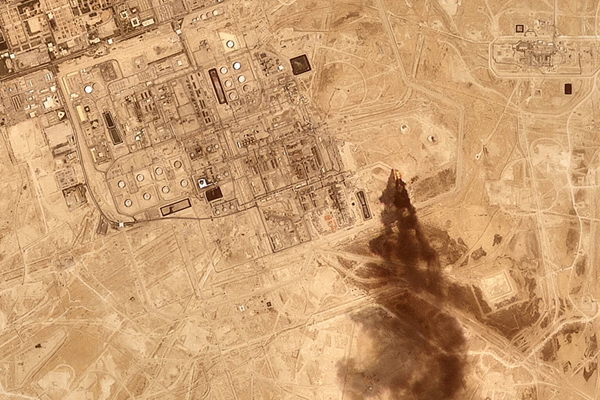
Planet Labs satellite imagery from Monday analyzed by The Associated Press showed damage to Saudi Aramco’s Abqaiq oil processing facility in the kingdom’s east. The massive facility is capable of processing approximately 7 million barrels of crude oil per day.
In 2019, attacks on Abqaiq claimed by the Houthis disrupted production of 5.7 million barrels per day, spiking global oil prices and providing an initial demonstration of the vulnerability of Saudi oil facilities to missile and drone attacks.
Separately, a regional official said an oil refinery in Jazan, on Saudi Arabia’s Red Sea coast, has temporarily shut down due to “relatively significant” damage from a Houthi attack on Saturday. The official, who was not authorized to brief journalists and spoke on condition of anonymity, said it would take several days to be repaired. The refinery produces 400,000 barrels per day.
The Texas-based IIR Energy consultancy said the refinery was tentatively expected to restart on Aug. 15.
Iran rejects Oman proposal for managing Strait of Hormuz
The Strait of Hormuz has been a major flashpoint in the conflict. Iran’s deputy foreign minister said his country rejected a proposal by Oman, which lies on the other side of the strait, for jointly managing ship traffic.
In an interview with Iran’s state-run television that aired Tuesday night, Kazem Gharibabadi said the Omani proposal included dividing the strait into two routes, each allowing the transit of 50% of shipping through the waterway.
Iran offered a counterproposal with a temporary plan for transit of vessels through its territorial waters, he said, adding that Iran’s policy is for the strait “never to return to its prewar situation.” Before the conflict ships transited freely.