Tens of thousands of people are stranded in the Middle East as Iran war complicates routes home
BERLIN (AP) — Tens of thousands of people, from Romanian religious pilgrims to tourists and diplomats’ family members, are stranded across the Middle East as the Iran war spreads.
Major airlines have canceled flights to and from the region, and airspace across the Gulf is closed. Some of those who are stuck have been forced to seek shelter because of airstrikes, while others are marooned on cruise ships, which currently can’t sail through the Strait of Hormuz.
In a major move on Monday, the U.S. State Department urged all Americans to leave more than a dozen Middle Eastern countries because of safety risks from the ongoing escalations that have dragged the region into significant chaos.
U.S. Assistant Secretary of State for Consular Affairs Mora Namdar said on X that Americans in countries including Iran, Iraq, Jordan, Lebanon and Israel should “DEPART NOW,” using any available commercial transportation.
The U.S. State Department has also evacuated nonemergency personnel and families in six nations, adding the United Arab Emirates to its list on Tuesday. The UAE, home to Dubai and Abu Dhabi and long considered a safe place in the Middle East, has been dragged into the Iran war with interceptions and attacks.
Mike Huckabee, the U.S. ambassador to Israel, meanwhile, told Americans there that the best way to leave is through Egypt’s Sinai Peninsula.
Repatriation flights
Governments worldwide are scrambling to get their citizens home.
Twenty-four flights from the UAE and Oman were scheduled to land in Russia on Tuesday, bringing back around 4,500 people, the Russian Transport Ministry said. About 1,000 people have already returned to Russia aboard flights from the two Middle Eastern countries on Monday night and Tuesday morning, according to the ministry.
As of Saturday, around 50,000 Russian tourists remained in the UAE, according to Russia’s Association of Tour Operators. The country has become a popular tourist destination for Russians in recent years, as they can take direct flights there and get a free 90-day visa upon arrival.
In Italy, the government has assisted with flights to Milan and Rome in the wake of mounting criticism against Defense Minister Guido Crosetto. The minister sparked a political controversy at home, after being stuck in Dubai with his family during the initial phase of the U.S.-Israeli attack on Iran.
Crosetto returned to Rome on Sunday on a military aircraft. The left-wing opposition has called for Crosetto’s resignation, saying he shouldn’t have traveled to the Middle East during a crisis. Italian Premier Giorgia Meloni has defended him.
An estimated 30,000 German tourists remained on cruise ships, in hotels or at closed airports in the Middle East, and the first plane from Dubai to Frankfurt, Germany, landed Tuesday afternoon.
The German government is also seeking to charter planes at taxpayer expense to get vulnerable people — including ill travelers, children and the pregnant — back home.
France is also trying to organize the return of thousands of French people, the country’s foreign affairs minister said Tuesday. An estimated 200,000 French people live in the region affected by the conflict, and authorities believe roughly 25,000 French citizens are visiting the area.
Returning travelers feel relief
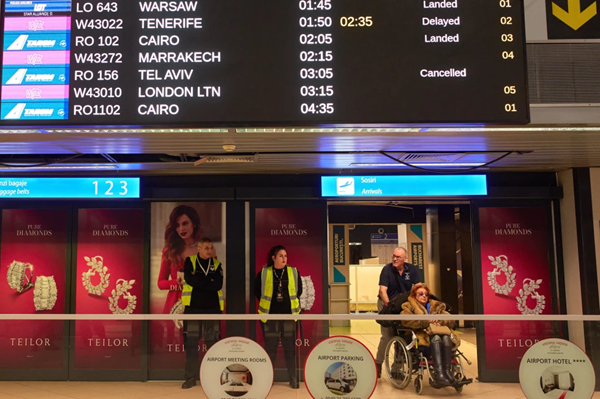
Early Tuesday, Romanian tourists arrived in Bucharest after traveling from Israel to Cairo to escape the conflict. Hundreds of Romanian Orthodox Church pilgrims were stranded in Israel while visiting Bethlehem on a trip led by Romanian priests when the war broke out. The group was forced to cut their trip short and return to Romania.
Pilgrim Mariana Muicaru said she was terrified during her time in Israel as rockets flew across the sky.
“We called our children at 3 a.m. to ask forgiveness because we might die and to tell them we love them and to let them know that it’s over for us,” she told The Associated Press.
Louise Herrle, a retiree from Pennsylvania, got stranded in Dubai with her husband when the conflict broke out. They had been vacationing in Dubai and Abu Dhabi, and are struggling to find a way to get back home.
“We’ve had several flights canceled,” she told the AP from her hotel in Dubai on Tuesday. “We are now scheduled to go out Thursday at 2:30 in the morning, and, you know, we don’t know if it’s gonna happen or not.”
Herrle said that she’s made it a habit to register with the U.S. State Department before traveling abroad. In the end, she says it’s her approach to life that’s helped her most: “Just accept the fact that we can’t control (the situation) … and go from there.”
In Germany, however, travelers deplaned at the Frankfurt airport Tuesday afternoon following a flight from Dubai. They were asked by reporters if they were glad to be home.
“Yes, of course,” Wassim Mahlas said. “I’m breathing German air again.”