Youth Court Day at Mississippi capitol focuses on improvements
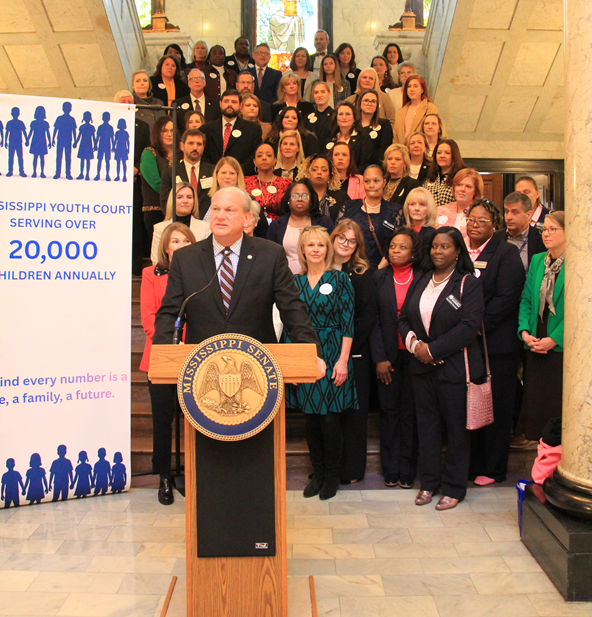
JACKSON, Miss. Improvements to the Youth Court system are again before the Mississippi Legislature, and representatives of the judiciary and many professional disciplines committed to the well-being of children were at the Capitol on Tuesday, Jan. 20, to discuss proposed legislation.
The Administrative Office of Courts organized Youth Court Day at the Capitol. Sen. Judiciary A Committee Chairman Brice Wiggins of Pascagoula spoke to judges, court staff, agency representatives, mental health professionals, social workers, attorneys, CASA volunteers and others involved in the child welfare system.
Sen. Wiggins said that the Senate and the House of Representatives for the past two years have done research on the needs of children and the Youth Court system that serves them. He said, “What we are here to do is to take it to the next level. We want the reforms to last and be sustainable.”
Among those proposed reforms is a uniform Youth Court system. In the current system, 24 courts have full-time County Court judges, only four of whom hear just Youth Court matters. A chancellor hears Youth Court matters in two counties. In the remaining counties, Youth Court matters are heard by a Youth Court Referee, an attorney appointed by the Chancery Court.
Multiple models have been proposed to create a uniform Youth Court system. Sen. Wiggins pointed to Gov. Tate Reeves’ proposal to add more Chancellors to hear Youth Court matters.
More funding and greater transparency are also to be considered, Sen. Wiggins said.
There is a need to reduce the time it takes to get children under the jurisdiction of the Youth Court to permanent homes. “It is taking way too long to get them through the system,” Sen. Wiggins said.
Also, reforms could finally get the state out from under the Olivia Y class action lawsuit which began in 2004. The lawsuit alleged that Mississippi’s foster care system failed to adequately protect children in its custody. The system remains subject to monitoring and reporting to the U.S. District Court.
The Administrative Office of Courts’ Youth Court Division has worked with multiple consultants to provide detailed information to the Legislature, state agencies and Youth Courts to develop and implement a multi-year strategic plan that includes statewide reforms, funding strategies and evidence-based best practices to better serve children, youth and families.
Twelve recommendations proposed by consultants who worked with AOC include:
- A system of full-time Youth Court judges and court staff. Such a system is estimated to cost between $7.3 million and $9.8 million.
- A uniform intake system. Youth Court, Child Protection Services and the Mississippi Department of Human Services Division of Youth Services should employ a consistent set of research-based policies and practices governing intake, screening and assessment, court decision making, and supervision and service. The Administrative Office of Courts is requesting legislative appropriation of $2.5 million to continue to pay Youth Court intake officers authorized by the 2025 Legislature and to train all intake officers statewide on uniform protocols.
- High quality independent legal representation for parents and all other parties in Youth Court proceedings. Some of the legal representation could be reimbursed through federal funding.
- Agency directed assessment and determination whether to pursue a matter in Youth Court.
- An agency representation model in which attorneys for the child welfare agency represent the agency as the petitioner in child welfare proceedings before the Youth Court.
- Statewide diversion. Youth who are at low risk of reoffending, as well as youth who commit first-time minor misdemeanors should be diverted from court involvement. Youth at high risk of reoffending should be prioritized for more intensive services and support.
- Designate Youth Courts as the only courts to hear truancy matters.
- Expanded and dedicated prevention programs and services.
- Uniform crossover youth protocol. Develop policy and protocol for collaboration to support needs of “crossover” youth who have contact with both the child welfare side regarding abuse and neglect as well as the delinquency side of the Youth Court system.
- Replace an outdated Youth Court records and case management system with modern technology. AOC is requesting $8 million to replace the records and case management system. Building the system is estimated to take 32 months.
- Provide all parties and their attorneys equal access to Youth Court records, and provide greater access to Youth Court for attorneys interested in this area of law.
- Maximize funding. Interagency collaboration could help maximize use of all federal and state funding streams.